Most leaders are trained to think from the neck up.
Strategy.
Vision.
Communication.
Decision-making.
Problem-solving.
Emotional intelligence.
Time management.
Team development.
All of it matters.
But there is a truth that often gets ignored in leadership development:
The body is where performance begins.
Before you lead a meeting, you bring a body into the room.
Before you make a decision, your nervous system is already influencing how clearly you think.
Before you communicate under pressure, your breath is shaping your tone, pace, and emotional control.
Before you inspire confidence in others, your own physical presence is speaking for you.
Leadership is not only intellectual.
Leadership is physical.
At Atlas Performance, we believe executive performance begins with the body because the body carries the full weight of responsibility, pressure, ambition, and purpose.
And when the body is undertrained, overworked, poorly recovered, and disconnected, leadership eventually suffers.
The Body Is the First Signal
Before you say a word, people feel your presence.
They notice how you walk in.
How you stand.
How you breathe.
How grounded you seem.
How much energy you carry.
How composed you are when pressure enters the room.
Presence is not just charisma.
Presence is physiology.
A strong, well-regulated body communicates stability. A tired, collapsed, overstressed body communicates something else entirely, even when the words are polished.
This does not mean leaders need to look like professional athletes. It means the body must support the role the leader is trying to occupy.
If you want to lead with confidence, clarity, and authority, your physical system has to be trained to carry that standard.
The body is always speaking.
The question is whether it is saying what you want it to say.
Performance Is More Than Productivity
Many executives and high-performing professionals are excellent at producing.
They know how to work.
They know how to sacrifice.
They know how to push through.
They know how to get things done.
But productivity is not the same as performance.
Productivity asks, “How much can I complete?”
Performance asks, “How well can I sustain excellence under pressure?”
That difference matters.
A person can be productive and still be exhausted.
Productive and still be stiff.
Productive and still be reactive.
Productive and still be sleeping poorly.
Productive and still be losing physical confidence.
Productive and still be one stressful season away from breakdown.
Executive performance requires more than output.
It requires capacity.
Capacity to think clearly.
Capacity to recover.
Capacity to communicate well.
Capacity to regulate emotion.
Capacity to move through long days without falling apart.
Capacity to show up at home with something still left to give.
That capacity begins in the body.
The Cost of Physical Neglect
Physical neglect rarely announces itself all at once.
It arrives quietly.
A little less energy in the morning.
A little more stiffness after sitting.
A little more tension in the neck and shoulders.
A little more weight around the waist.
A little less patience at the end of the day.
A little more reliance on caffeine.
A little more difficulty falling asleep.
A little less confidence in the mirror.
Then one day, the person who used to feel strong, athletic, capable, and in control realizes they have been living outside of their body for years.
They are still succeeding professionally, but physically they feel disconnected.
That disconnect matters.
Because the body is not separate from leadership. It is the foundation leadership stands on.
When the body loses capacity, the mind has to work harder. When the nervous system is always elevated, emotional control becomes harder. When sleep suffers, decision-making suffers. When posture collapses, breathing suffers. When energy is unstable, presence becomes harder to sustain.
The body keeps the score.
And eventually, the body sends the invoice.
Energy Is a Leadership Asset
Energy changes everything.
A high-energy leader does not simply move faster. They create momentum. They bring life into a room. They elevate the standard around them.
A low-energy leader may still be intelligent, experienced, and capable, but the room feels different.
Their tone may flatten.
Their posture may collapse.
Their patience may shorten.
Their vision may narrow.
Their confidence may become less visible.
Their ability to inspire may decrease.
This is why energy should be treated as a leadership asset.
Not a luxury.
Not a bonus.
Not something to address after everything else is handled.
Energy is part of the work.
And energy is physical.
It is affected by training, sleep, hydration, nutrition, breathing patterns, recovery, stress load, and movement quality.
You cannot consistently lead at a high level from a depleted body.
At some point, the system has to be rebuilt.
The Nervous System Leads Before the Words Do
Under pressure, leadership becomes less about what you know and more about what you can access.
Can you stay composed?
Can you listen without becoming defensive?
Can you speak clearly when the stakes are high?
Can you slow yourself down enough to make a better decision?
Can you respond instead of react?
These are not just mindset skills.
They are nervous system skills.
A dysregulated body tends to rush, brace, tighten, interrupt, over-explain, shut down, or overreact. A regulated body has more space. More control. More choice.
This is why breathwork is a central part of the Atlas Performance system.
Breath is the bridge between body and mind.
A leader who learns to control the breath gains access to a more controlled state. That state influences communication, decision-making, emotional regulation, and executive presence.
Before you manage the room, you have to manage your state.
Posture and Presence Are Connected
Posture is not just a physical issue.
It is a performance issue.
Modern work pulls the body forward. Hours at a desk, phone use, commuting, stress, and fatigue all reinforce a collapsed position.
Shoulders round.
Chest tightens.
Hips stiffen.
Spine loses mobility.
Breathing becomes shallow.
The head moves forward.
The body begins to look and feel compressed.
This affects more than movement.
It affects how you breathe.
How you project your voice.
How much energy you feel.
How confident you appear.
How your body handles stress.
A leader who is physically collapsed may have to work harder to project strength and clarity. A leader who is upright, grounded, mobile, and strong naturally communicates more presence.
At Atlas, we do not train posture as a cosmetic correction.
We train it as part of executive performance.
Because how you carry yourself shapes how you experience yourself.
Confidence Is Built Through Physical Evidence
Confidence is not only something you tell yourself.
It is something your body learns through evidence.
Every time you train with intention, you send a message to yourself:
I can do hard things.
I can improve.
I can rebuild.
I can stay consistent.
I can regain control.
I can trust my body again.
For many high performers, training becomes the place where confidence is restored.
Not because every workout is perfect.
But because the process creates proof.
The body starts to change.
Energy improves.
Strength returns.
Posture opens.
Movement feels smoother.
Breathing becomes more controlled.
Recovery becomes more intentional.
The person begins to recognize themselves again.
That physical evidence matters.
When you feel more capable in your body, you carry yourself differently in the world.
Executive Performance Requires an Integrated System
The modern executive does not need random intensity.
They need intelligent structure.
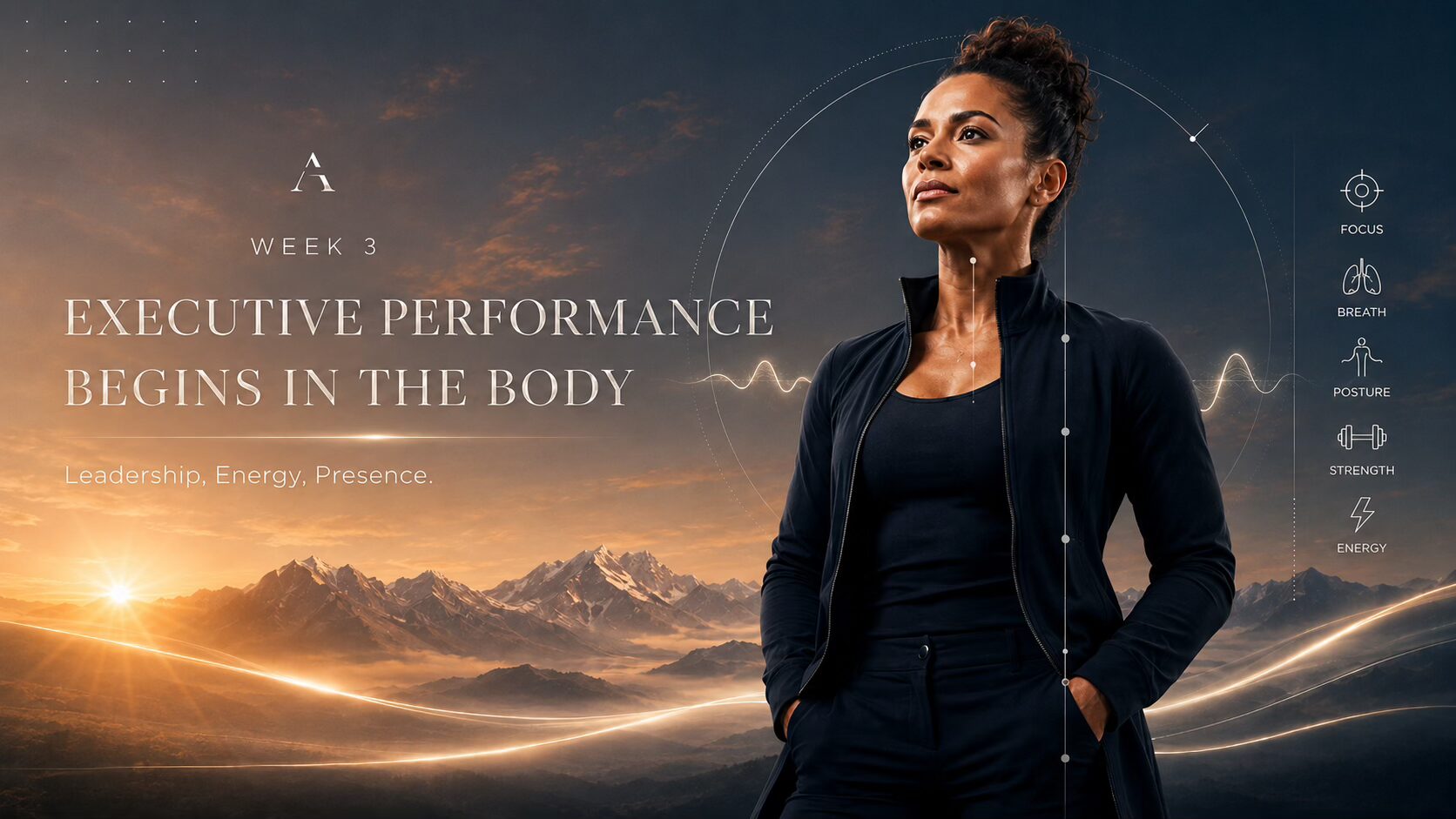
At Atlas Performance, we build executive performance around five essential functions:
Regulate the nervous system through breath and recovery practices.
Activate the body through strength, mobility, balance, and movement training.
Center awareness so the leader can understand their body’s signals in real time.
Fuel the system with nutrition that supports energy, cognition, and recovery.
Restore through sleep hygiene, rest, and sustainable recovery rhythms.
This is not simply a fitness plan.
It is a performance development system.
The goal is not to exhaust the leader.
The goal is to increase capacity.
A stronger body.
A calmer nervous system.
A clearer mind.
A more confident presence.
A more sustainable rhythm of performance.
The Executive Body Must Be Trained for Real Life
Most executives are not training for a scoreboard.
They are training for life.
For demanding workdays.
For difficult conversations.
For travel.
For presentations.
For family responsibilities.
For long meetings.
For stress.
For leadership moments that require clarity and composure.
The training should reflect that.
You need strength that supports posture.
Mobility that keeps the body open.
Core control that protects the spine.
Conditioning that improves stamina.
Breathwork that regulates stress.
Recovery habits that preserve energy.
Nutrition that supports focus.
This is performance training for the modern life arena.
The boardroom.
The office.
The airport.
The home.
The community.
The field of responsibility.
The goal is to build a body that can meet the moment.
When the Body Changes, Leadership Changes
Something powerful happens when a leader begins rebuilding the body.
They stand taller.
They breathe deeper.
They move with more intention.
They speak with more groundedness.
They recover faster.
They become more aware of stress before it takes over.
They begin making better decisions for themselves.
They begin leading from a place of greater self-respect.
The transformation is not only physical.
It becomes behavioral.
Because discipline in the body often creates discipline elsewhere.
When you keep promises to your health, you strengthen your relationship with yourself. When you train consistently, you become more familiar with effort, discomfort, recovery, and progress. When you regulate your body, you create more space for wisdom.
The body becomes a training ground for leadership.
The Atlas Standard for Executive Performance
At Atlas Performance, we do not believe executive performance is about grinding harder.
Most leaders already know how to grind.
The real work is learning how to build enough physical, mental, and emotional capacity to lead well without losing yourself in the process.
That requires a higher standard.
Not just fitness.
Not just appearance.
Not just intensity.
Not just discipline for discipline’s sake.
It requires embodiment.
The ability to live in a body that supports your ambition, your leadership, your relationships, and your purpose.
A body that is strong enough to carry responsibility.
Mobile enough to move with freedom.
Regulated enough to stay composed.
Recovered enough to keep growing.
Fueled enough to sustain energy.
Aware enough to respond with intelligence.
That is the Atlas Standard.
The Question Every Leader Should Ask
Do not only ask:
“How successful am I?”
Ask:
“Is my body capable of supporting the next level of my life?”
Because the next level will ask more of you.
More responsibility.
More pressure.
More decisions.
More visibility.
More leadership.
More energy.
More presence.
The body has to be prepared for that.
Executive performance begins in the body because the body is where ambition becomes action. It is where pressure is carried. It is where confidence is expressed. It is where energy is generated. It is where leadership becomes visible.
Your body is not separate from your work.
It is one of your greatest leadership tools.
Train it accordingly.
Move with power. Lead with presence. Live with purpose.